
What really prevented that stroke?
A 52 year old man walks into a primary care clinic in Bangladesh. His blood pressure is checked and found to be high again on a second visit. The doctor gives him advice about health behaviours and starts him on two inexpensive medications. Years later, he doesn’t have a stroke.
It’s natural to give the doctor the credit for that, and some of it belongs there. But if we want to know what actually made the difference, the more useful question is what would have had to change for that man to have his stroke anyway.
If that particular doctor had been off sick, a colleague would very likely have measured the same blood pressure and written the same prescription. But there are other parts of the story that couldn’t be swapped out so easily.
The chain behind the consultation
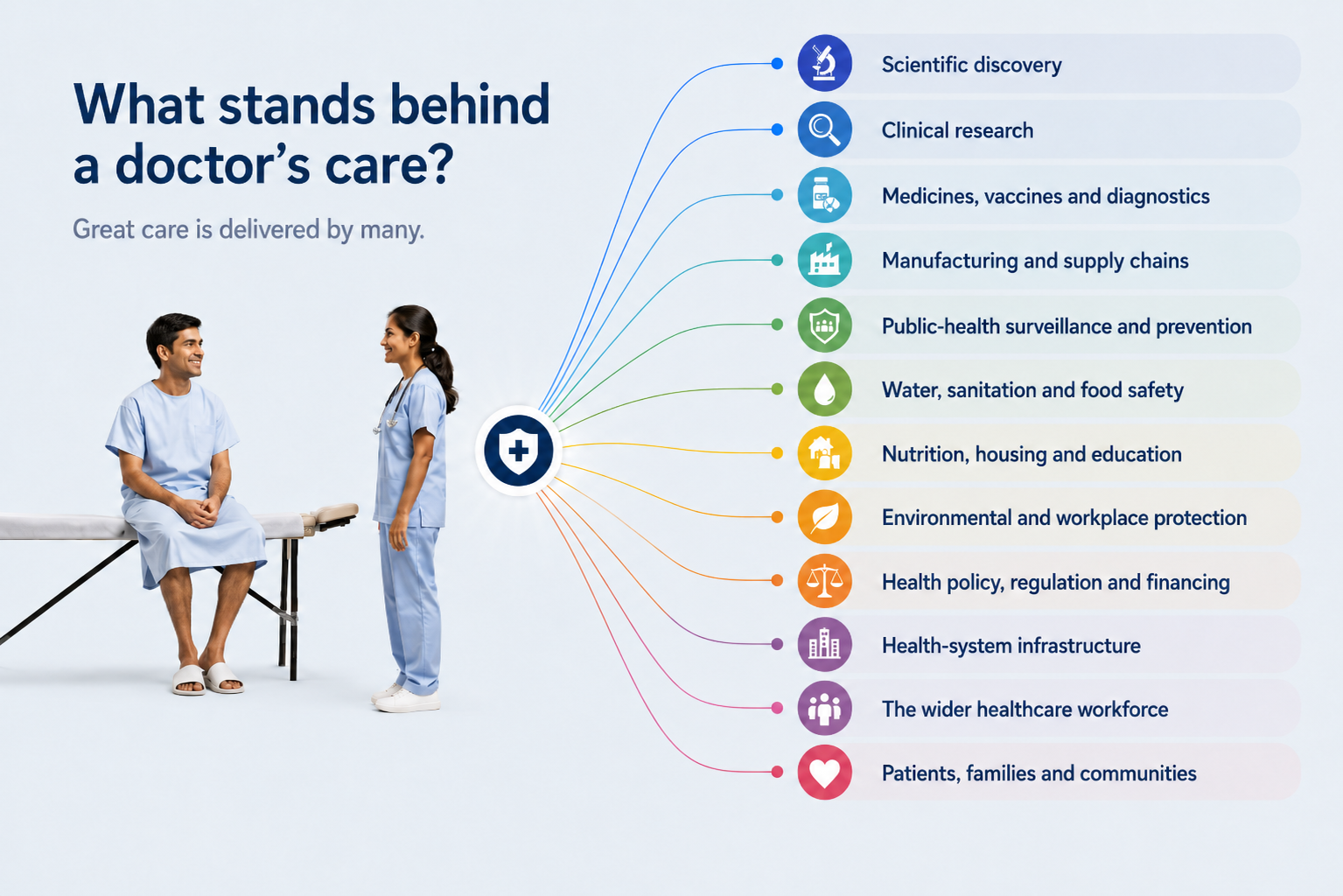
Someone had to work out that treating blood pressure prevents strokes, establish which patients benefit, what target BP to aim for, and get the drugs past regulators. Someone had to manufacture amlodipine cheaply and build supply chains that don’t stock out. Someone decided blood pressure should be measured routinely, wrote the treatment protocol, made the protocol widely available to health centres, trained the primary care team, and figured out who pays for the visit, the tests and the tablets. Someone did the research to show that cutting dietary salt, eliminating industrial trans fats and reducing tobacco use prevents cardiovascular disease. And someone did the slow political work of turning that evidence into regulations.
We think of this doctor preventing a stroke by identifying the risk and prescribing medication, but that is the last step in a long chain of contributing events.
Where the failures actually are
Hypertension is not a rich country problem. WHO estimates that 1.4 billion adults aged 30 to 79 had hypertension in 2024, two-thirds of them in low- and middle-income countries (LMICs). Around 44% of them don’t know they have it. Only about 23% have it controlled.
Effective generic drugs have existed for decades and cost very little, so why are so few people diagnosed and treated? The implementation gap is made up of missing protocols, untrained teams, unvalidated devices, stockouts, inadequate follow-up and consultations patients can’t afford.
Much of this is fixable. WHO’s HEARTS package runs in more than 40 LMICs, with 13.5 million people on protocol-based treatment. The Bangladesh Hypertension Control Initiative increased control rates in four districts from 26% to 46% over two years, and modelling of a national scale-up projected around 9,400 lives saved.
So the list of people who prevented that man’s stroke includes the doctor, but is longer than it first appeared. Some of them will contribute to the care of millions of patients they’ll never meet. Clinical medicine is the most visible part, but the rest of the chain is no less impactful for being invisible.
Further upstream is not automatically better
Clinical work is not necessarily of low value, and work in policy or research does not necessarily “beat” clinical practice. The size of your contribution depends on where the bottlenecks are, not on how far up the chain you work. A policy role in a country that already has decent protocols and a working supply chain may change very little, while clinical work in a region with a handful of doctors per 100,000 people can be enormously impactful. So the question to ask about any role is not how upstream it is. Ask whether the work addresses the actual bottleneck, how many capable people are already working on it, and whether you would be any good at it.
Try working backwards
Pick an intervention that substantially improves the health of one of your patients, and work backwards from it:
What research made the intervention possible?
What determines whether it reaches the patient at all?
Which people, devices, drugs, supply chains, payment systems and policies does it depend on?
What stops it reaching the people in need of it?
Who is working on those problems now, and what is still missing?
Somewhere in that chain there is often a pain-point where one more person, organization, study or policy change would improve care for large numbers of people. That is a much better starting point for a career than choosing a specialty and hoping the impact arrives later. Identify an important, solvable but neglected problem you’d be willing to spend years on, then choose the pathway that gets you working on a bottleneck.
The doctor in the room with the patient matters a lot. But they are one part of a long chain, where there is also important and often much more impactful work to be done.
If you'd like to explore this thinking further and relate it to your own circumstances, then apply to join our next Career Planning Course. Not a medical student or doctor? Then ask for a 1:1 call to discuss things.