Planning a highly impactful career in the age of AI
The rapid evolution of AI challenges us to consider what the future of work will look like, and how we will each find our place in that new career landscape. AI is already changing the nature of work involved in many jobs. For those seeking to have highly impactful careers, the question now is not so much whether a particular profession or career path is “safe from being replaced by AI”. It’s more helpful to ask how AI might change the effort to solve important, neglected health problems, and where we each might still add unusual value in the age of AI.
AI will transform many occupations
AI is likely to transform most occupations, rather than completely eliminate them. The ILO's refined index of generative AI exposure notes that most jobs are composed of many different tasks that AI will be able to complete to different extents. The UN's Independent International Scientific Panel on AI concludes that, “labour-market effects are best framed around tasks, new work creation and job quality rather than simple displacement."
We can think of a clinical medical job broken down into tasks of history-taking, compiling a differential diagnosis, interpreting investigations, communicating and explaining uncertainty, doing procedures, coordinating care, documenting all of what’s happening, and taking responsibility for what happens next. Similarly, a public health, policy, or non-profit role bundles evidence synthesis, writing, negotiation, fundraising, leadership, collaborating with stakeholders, and other tasks.
AI is already faster at routine writing, summarizing, coding, drafting, and first-pass analysis. But physical tasks, trust, complex judgement, leadership, and accountability are likely to still depend on people.
Where doctors are likely to remain most valuable
Kate Tulenko (Corvus Health, Johns Hopkins) splits healthcare work into intellectual, kinetic, and emotional domains. For Hi-Med participant’s needs, I would add another domain: organizational work.
Intellectual work is diagnosis, evidence synthesis, writing, coding, policy drafting, etc. AI is already strong in this domain, but the American Medical Association highlights the idea of “augmented intelligence”, where AI supports human intellectual work and judgement, rather than replacing it. Task-specific diagnostic tools are validated and many are already deployed. One national digital health app has measured 93% diagnostic accuracy, and community health worker tools in Rwanda and Kenya show real gains in accuracy of triage. They can be introduced within current regulatory frameworks because they're built and tested for one job. Development of general-purpose healthcare chatbots is a different challenge, because of the breadth of what they are trying to achieve. They can cut administrative documentation time well, but they aren't yet validated for diagnosis.
Kinetic work is physical: physical examination, procedures, surgery. Robotics hasn't caught up here.
Emotional work includes the hard conversations, the uncertain prognosis, communications with the critically ill and their loved ones. It still needs someone who can build trust and take responsibility.
Organizational work: setting priorities, leading teams, allocating funds, influencing policy, founding organizations. This matters especially in non-clinical and portfolio career paths. Succeeding in non-clinical roles (including medical leadership positions) requires tackling challenges in coordination, collaboration, incentives and implementation.
Which tasks may become vulnerable earliest?
There are detailed reports on the levels of exposure of different jobs and tasks to AI (ILO), and on generative AI's economic potential (McKinsey). AI has moved fastest on tasks that are digital, routine, and easy to check against a known standard. In medicine, this includes documentation, routine triage, first-pass reads of common investigations. Outside medicine, it includes report drafting, literature summaries, standard communications.
Which skills should you build?
In his 80,000 Hours career guidance book, Benjamin Todd argues that the best skills to build are transferable, fast to learn relative to their value, and made more valuable by AI, not less. These skills form five clusters (Table).
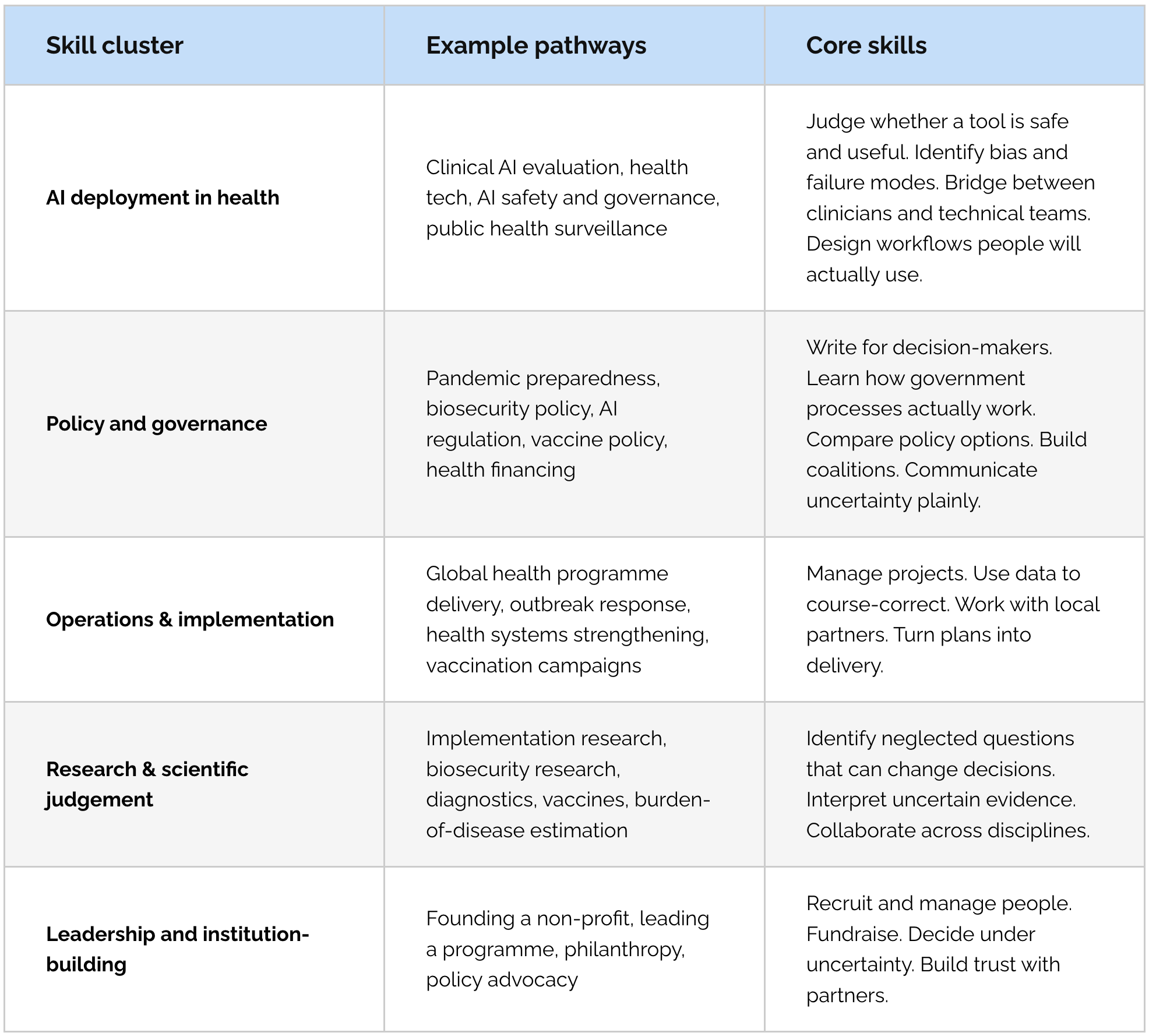
AI literacy is necessary and building this must be your priority, but it is not sufficient. Build career capital from combining medical knowledge with one or two of these skill clusters, chosen for problems that are also important, tractable, and neglected.
AI literacy is expected in every pathway
Whatever your career pathway, AI must be a central tool in your development, not a side interest for some people only. Embrace its use now - e.g. use it for summarizing non-confidential material, comparing arguments, planning projects, checking your own reasoning. Get used to defining tasks clearly, testing outputs, checking sources, knowing when a human needs to check the work.
Prioritize learning and using each new development as it becomes available. Avoid falling behind, because the field is moving so quickly. Microsoft's 2025 Work Trend Index found that people who use AI regularly redesign their work around it, while people who don't may not notice how much has already changed.
Career resilience is not the same as career impact
A job can be resistant to automation, but still have little impact. A role can also be highly exposed to AI and become more valuable, because AI significantly expands what one person can do.
For example, routine policy drafting is likely to be taken over by AI. But helping a government adopt an effective policy involves skills that AI is unlikely to replace and thus remains highly valuable. Routine literature review will likely automate too, but picking an important, neglected research question and building the team to answer it becomes more valuable, not less.
Instead of focusing on finding a career that AI can't touch, think about how to work on important problems where AI increases what you can contribute, where you can build the human skills that turn knowledge into outcomes.

Predicting the future is hard
Always remember that any predictions about where AI is best, and where it will struggle, will be wrong in places. You need to stay aware of multiple forecasts and don’t be too attached to one opinion.
Recent employment data (discussed in the UN report) disagree on how large the effect of AI has been so far: US workers aged 22 to 25 in AI-exposed occupations saw roughly 15% relative employment declines in one study; but a Danish study over the same period found close to zero effect on hours, wages, or hiring.
A decision framework for Hi-Med participants
For any career path you're considering, ask yourself the following questions:
• How important, tractable, and neglected is the problem?
• Which parts of the work will AI make easier, and which could be automated outright?
• If AI does those parts well, what's left: physical action, trust, communication, coordination, leadership, accountability, implementation?
• Does AI increase your potential impact in this specific role?
• What skills should you build next: AI deployment skills, policy knowledge, operations experience, research judgement, or organizational leadership?
Some practical recommendations
Use AI regularly, prioritize building and broadening your skills to stay up to date with developments and avoid falling behind.
Don't build your value around one narrow cognitive task. Build your strength in at least one strong human complement too, such as a procedural skill, complex care, complex communications, policy or program implementation, or organization-building.
Consider a portfolio career to test a second pathway, especially if thinking about leaving clinical medicine. Clinical work is a source of insight and credibility, and can be a helpful supplement on your pathway to impact.
Talk regularly to people already combining medicine with public health, AI, policy, biosecurity, or philanthropy - hear their experiences and opinions. Set a target to have a coffee chat every week, or every month (depending on how active your career change process is at the time).
AI will change most of the careers Hi-Med participants are weighing. Build yours around where the bottlenecks move next.
We would love to hear what you think about this - what do you agree or disagree with, what has been your personal experience, what do you worry about? Why not post your thoughts on the Hi-Med Slack.
The first draft of this article was written by Simon Ling, and subsequently edited and improved with the help of LLMs.