Why are some big health problems neglected?

A venomous snake bites a farm worker in rural India. Whether he survives depends on whether he can reach a hospital quickly enough, whether the hospital has the right antivenom, and whether staff are trained to use it.
Contents:
- Why don’t resources follow the need?
- Is it a bottleneck?
- Snakebite: neglected from end to end
- Lead exposure: a huge burden, little funding
- Opportunities in tuberculosis
- How to tell whether a problem is neglected
- Mind the gap
Snakebite is an example of a neglected, important problem. WHO estimates that up to 2.7 million envenoming snake bites cause 81,000–138,000 deaths each year, as well as many more amputations and other permanent disabilities. Most events occur in poor rural communities in Africa, Asia and South America. Yet snakebite continues to receive little research funding, commercial investment or political attention.
Understanding neglectedness matters when you’re planning an impactful career. By joining a field alongside thousands of well-funded workers, for example, you may achieve far less impact than by bringing your skills to an important area where critical work is not being done due to inadequate human and other resources. The same idea applies to our philanthropic donations.
Why don’t resources follow the need?
Disease burden does not automatically dictate the extent of research funding, philanthropic and government funding for implementation, commercial interests, political attention and professional effort. The resources attracted to solving a problem are determined by many other factors.
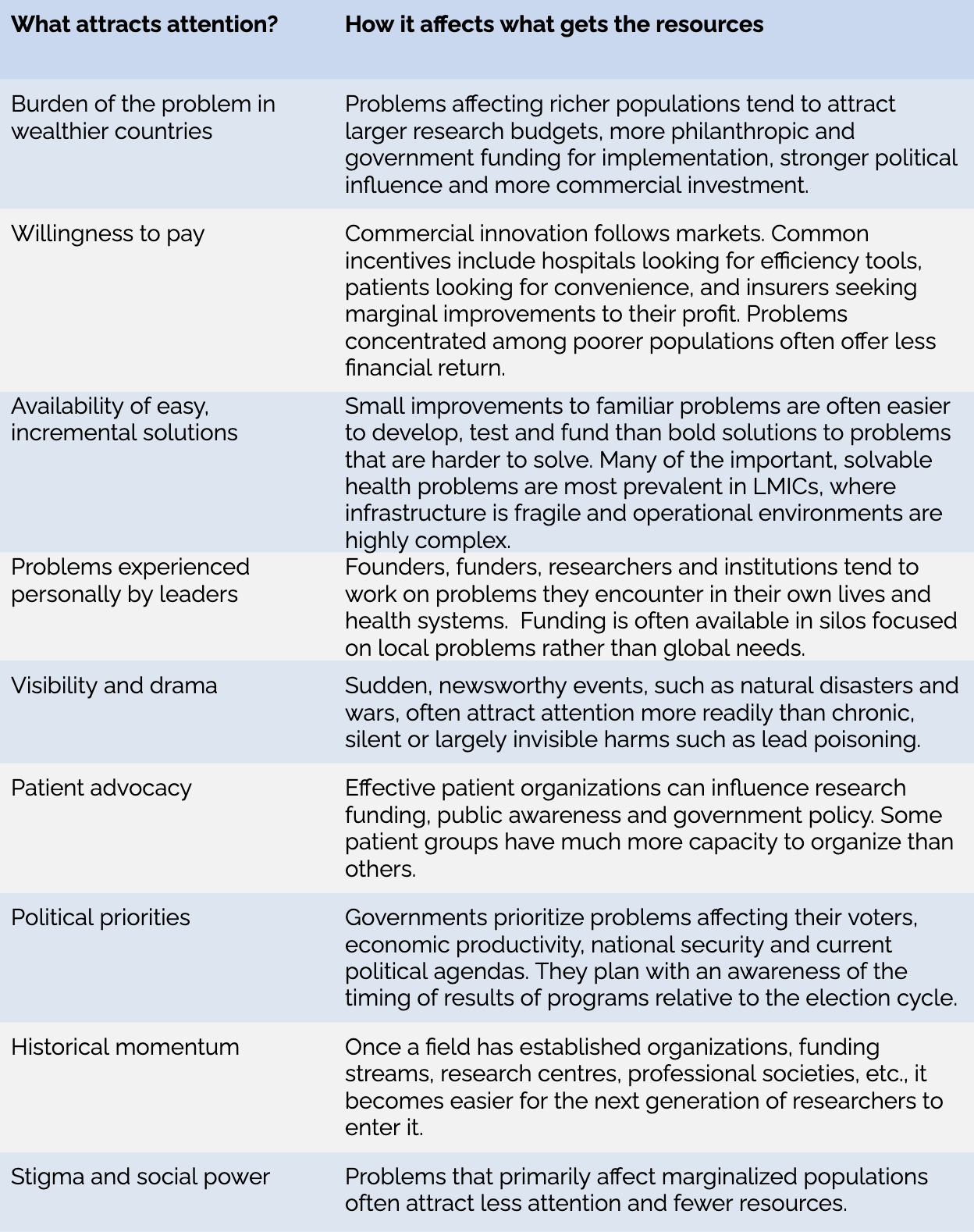
Note that none of these factors necessarily tells us how much suffering a problem causes or how impactful an intervention may be.
Is it a bottleneck?
In some cases, a problem may receive relatively little attention throughout the whole length of the pathway to solving it. Snakebite is a good example in which there is little research, weak commercial incentives, few specialist organizations, limited political attention and inadequate healthcare provision.
In other cases, a major disease area may receive large amounts of funding for thousands of people employed to find and implement a solution, but progress is impeded by one critical point in the pathway that is inadequately addressed.
There is a lengthy and complex chain of events from understanding a disease and its cause, through understanding how to diagnose, prevent and treat the disease effectively, affordable production and procurement of the necessary intervention(s), relevant policy and financing for the treatment or prevention program, all the way to delivery of the intervention to patients or populations. If one link in this chain is particularly weak, it becomes the critical bottleneck. Finding and solving the bottleneck is another way to increase the impact of the work you’re doing, even in cause areas where overall resourcing seems adequate.
Snakebite: neglected from end to end
Snakebite predominantly affects farmers, children and others living in poor rural communities. Most deaths are preventable if effective antivenom is available and patients can reach it in time. Unfortunately access to antivenom is limited for many reasons, including the fact that few countries are able to produce suitable antivenoms, lack of regulatory systems to ensure adequate quality of available antivenoms, weak health systems, missing epidemiological data, disrupted supply chains, and inadequate training of healthcare workers. WHO therefore classifies snakebite envenoming as a neglected public-health problem.
Cures Within Reach is a non-profit organization funding trials of existing medicines for new uses and trying to help with snakebite. It provided $50,000 for a Phase 1 safety trial of oral unithiol in healthy volunteers in Kenya and these results supported a $5.4 million grant from Coefficient Giving (then Open Philanthropy) for a Phase 2B trial of oral unithiol and marimastat in Ghana and Brazil. If successful, such treatments might eventually be given much closer to where bites occur. Whilst this is still experimental research, it shows what relatively small amounts of money and research effort can do in a neglected field.
Lead exposure: a huge burden, little funding
Lead exposure is estimated to cause more than 1.5 million deaths each year (Coefficient Giving). Until recently, this problem received only $10–15 million a year in philanthropic funding. Malaria and tuberculosis, with broadly comparable global health burdens, attracted roughly one hundred times more.
Effective control of lead poisoning may be impeded by inadequate understanding of the source (lead exposure can arise from paint, spices, batteries, cookware and other consumer products), lack of alternative products or processes for industries, or absence of sufficiently strong government regulation and its enforcement.
In recent years, funders and non-profit organizations have begun to focus much more attention on this gap. Coefficient Giving’s Lead Exposure Action Fund (LEAF), launched in 2024, has now made more than 40 grants and directed over $60 million to lead exposure work, including grants to Pure Earth and the Lead Exposure Elimination Project (LEEP) (note that Hi-Med also receives funding from Coefficient Giving). LEEP’s work in Malawi helped the government introduce a national lead-paint ban, reducing leaded paint’s market share from 67% in 2021 to 24% in 2023. Pure Earth is currently receiving $17 million from LEAF for lead mitigation projects across more than ten countries or Indian states.
Opportunities in tuberculosis
Governments, researchers, the Global Fund, WHO and many large organizations have worked to reduce the burden of tuberculosis (TB) for decades. In spite of this, important bottlenecks remain, such as preventive care for contacts of infected family members. Young children living with someone who has TB are at especially high risk of developing TB disease that can be avoided by preventive treatment. Unfortunately, many eligible children do not get preventive treatment, demonstrating that it is not always obscure diseases that are neglected.
In 2024, GiveWell identified this potentially cost-effective gap in India and recommended a $15.1 million grant to the Clinton Health Access Initiative (CHAI) to support health workers in Bihar and Uttar Pradesh to visit households of people diagnosed with TB, screen family members and provide preventive treatment to young children. GiveWell estimates the programme at approximately eight times as cost-effective as unconditional cash transfers, although with substantial uncertainty. The programme is still underway and preliminary results are eagerly awaited.
So whilst TB is not considered a neglected disease overall, it remains a major cause of morbidity and mortality and this particular step is a bottleneck where additional effort and resources could make a big difference in preventing childhood TB.
How to tell whether a problem is neglected
When considering problem areas that may form the focus for your future impactful career, you will rarely be able to calculate neglectedness precisely. Here are some suggested steps to reach a reasonable estimate.
See whether others have already investigated it. GiveWell, Coefficient Giving, G-FINDER and other sources publish detailed analyses of global-health interventions and grants. Review articles in academic journals may also address relevant questions. Organizations such as 80,000 Hours and Probably Good can provide useful leads for career-related research. Check the extent to which the analyses provided by these organizations are relevant to your precise question and the context that you are investigating.
Define the problem narrowly. Whilst resourcing of “Cardiovascular disease” is overall provided at a very high level around the world (skewed by staffing, government funding and philanthropy in high income countries), “Detection and treatment of hypertension in rural Nigeria” is a different story. Neglectedness can vary enormously between countries, populations and different parts of the pathway to solving the same disease.
Estimate the burden. Look at deaths, disability adjusted life years (DALYs), numbers of people affected, and where the health burden primarily occurs. WHO's Global Health Estimates and the Global Burden of Disease study are good starting points.
Map the pathway to solving the problem. Where is progress getting stuck? Review articles in academic journals, blogs or organization information pages from those working in the area will help identify where the problems lie. Is there a deficiency in scientific understanding, prevention, diagnostics, treatment development, price, manufacturing, regulation, procurement, healthcare delivery or patient uptake? Which parts of the pathway already have substantial expertise and funding, and which do not?
Estimate how much effort is already directed towards it. Look for research expenditure, philanthropic and government funding, commercial investment, numbers of commercial or non-profit organizations, numbers of clinical trials and major research groups already working in the area.
Now you are in a position to develop a crude ratio of the health burden and the resources devoted to the problem. For example, you can compare DALYs with annual research funding or with the international aid budget directed to the problem.
AI can of course make the initial research faster and allow comparison across several disease areas and prevention/treatment pathways. To ensure accuracy, follow the references, check the steps and all the important numbers against the original sources.
Mind the gap
Finding an important, solvable but neglected problem to work on is a key part of planning your effective career. When there’s a gap between a problem’s importance and the resources being applied to it, there often lies an opportunity for impact that you’re seeking.